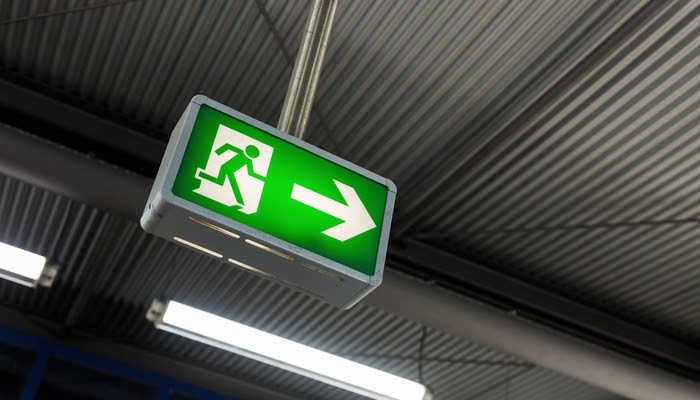
In the event of a serious incident in your workplace, your staff and customers will need to quickly and safely exit a potentially dangerous environment.
Exit & Emergency Light Testing — National Compliance Service
Appliance Tagging Services (ATS) is a national provider of exit and emergency lighting inspection and testing services, with qualified technicians operating across Australia in NSW, VIC, QLD, SA, WA, TAS, ACT and NT. ATS has over 20 years national experience in ensuring your workplace safety.
In the event of a fire, power failure or other serious emergency in your workplace, your exit and emergency lighting systems are often the only thing standing between your staff and customers finding safety quickly — or being left in the dark. A failed emergency light in an emergency is not just a compliance failure. It is a life-safety failure.
ATS helps Australian businesses of all sizes ensure their emergency lighting systems are tested, compliant and genuinely ready to work when it matters most.
What Are Exit and Emergency Lights?
Exit and emergency lighting systems are mandatory in most Australian commercial, industrial and public buildings. They serve two critical functions:
- Exit lights — illuminate designated evacuation routes and exits, guiding people toward safety
- Emergency lights — provide general illumination when normal power fails, allowing safe evacuation of a building
These systems operate independently of the main power supply, using battery backup to activate automatically when power is cut. Over time, batteries degrade, lamps fail, and circuits can develop faults — none of which are visible during normal operation. Only through regular formal testing can you confirm the system will actually work during an emergency.
Is Exit and Emergency Light Testing Required by Law in Australia?
Yes. Under the Building Code of Australia (BCA), all buildings required to have emergency lighting systems must comply with AS 2293.1 (Installation Standard). These systems must also be regularly inspected and tested in accordance with AS 2293.2 (Inspection and Maintenance Standard).
AS 2293.2 requires:
- 6-monthly inspections and tests — a formal discharge test to confirm the system operates correctly for its rated duration
- Annual compliance documentation — a full record of test results demonstrating ongoing compliance
Building owners, employers and facility managers all carry legal responsibilities for ensuring emergency lighting systems are maintained and tested. Failure to comply can result in fines, insurance complications, and serious legal liability in the event of an incident.
Who Is Responsible for Emergency Light Testing?
Responsibility for ensuring exit and emergency lights are tested and compliant typically falls to:
- Building owners — for common areas and the overall building system
- Employers and business occupiers — for the areas within their tenancy, under their WHS duty of care
- Facilities managers — typically coordinating compliance on behalf of building owners or employers
In shared buildings or multi-tenancy situations, responsibilities should be clearly defined in the lease agreement. ATS can assist with clarifying obligations and coordinating testing across complex sites.
How Often Must Emergency Lights Be Tested?
Under AS 2293.2, exit and emergency lighting systems must be:
- Tested every 6 months — a full discharge test to confirm the system operates for its rated duration (typically 90 minutes)
- Inspected monthly (recommended) — a visual check of indicator lights and general condition
- Fully documented — all test results recorded in an on-site logbook and compliance certificate
ATS provides automated reminder services to ensure your 6-monthly testing is never missed.
What Does ATS Exit & Emergency Light Testing Include?
ATS technicians are trained and qualified to inspect and test your system in full accordance with AS 2293.2. Our comprehensive service includes:
- Full discharge test — simulating power failure to confirm lights activate and run for the required duration
- Lamp and tube replacement — replacing any failed lamps or starters identified during testing
- Diffuser cleaning — cleaning covers and diffusers to maintain light output
- Fault identification — documenting all faults found for rectification
- Repair and replacement service — ATS can carry out repairs on-site where possible
- Compliance documentation — online compliance certificate and electronic logbook issued at the conclusion of every test visit, meeting all Fire Safety legislation and Essential Safety Measures requirements
All documentation is available digitally through ATS’s online reporting system, making compliance management simple for multi-site businesses.
What Building Types Require Emergency Light Testing?
Exit and emergency lighting testing is required in virtually all non-residential buildings in Australia, including:
- Commercial offices and retail premises
- Warehouses, factories and industrial facilities
- Aged care facilities and hospitals
- Schools, universities and childcare centres
- Hospitality venues — hotels, restaurants and entertainment venues
- Shopping centres and large retail stores
- Government buildings and council facilities
If your building has an emergency lighting system installed, it must be tested. ATS serves clients across all of these sectors nationally.
FluoroCycle — Responsible Lamp Disposal
ATS encourage all clients, large and small, to recycle their fluorescent lamps. ATS supports responsible fluorescent lamp recycling in line with the FluoroCycle program, administered by Lighting Council Australia via the FluoroCycle scheme.
Currently, 90% of all of fluorescent lamps are sent to landfill – which is contributing to dangerous levels of mercury in our environment.
ATS can provide you details on cost effective ways you can recycle your fluoro lamps and ensure electrical safety for future generations.
Frequently Asked Questions — Exit & Emergency Light Testing
What is AS 2293 and why does it matter? AS 2293 is the Australian Standard that governs emergency lighting systems in buildings. AS 2293.1 covers installation requirements, and AS 2293.2 covers inspection and maintenance. Compliance with AS 2293.2 is a legal requirement under the Building Code of Australia and Essential Safety Measures legislation in most states.
How long must emergency lights run during a discharge test? Most emergency lighting systems are rated for 90 minutes of operation. The discharge test confirms the system can run for its full rated duration when mains power is disconnected.
What happens if an emergency light fails its test? ATS will document the fault clearly in your compliance report and advise on the required repair or replacement. Depending on the fault, repairs can often be completed on the same visit.
Can ATS manage emergency light testing across multiple sites? Yes. ATS is one of Australia’s leading national providers with the capability to coordinate exit and emergency light testing across large portfolios of sites, with centralised reporting through our AIM Portal.
Does ATS provide the compliance certificate? Yes. At the conclusion of every test, ATS provides an online compliance certificate and an electronic logbook entry, satisfying all Fire Safety legislation and Essential Safety Measures documentation requirements.
Book Exit & Emergency Light Testing with ATS
ATS provides exit and emergency light testing nationally across Australia — NSW, VIC, QLD, SA, WA, TAS, ACT and NT. Call 1300 287 669 or use our online quote form to arrange testing with a local ATS technician.

Get a free quote
"*" indicates required fields
what our clients say…
Technicians were polite and efficient. They worked well in difficult conditions.
Cafe Xpresso, Katoomba
Technicians were competent and professional. They worked in a way to minimise the impact to our business
Sydney Trains, Sydney
Thank you for your wonderful service. We appreciate your workmanship and look forward to working with you!
Sebel, Sydney